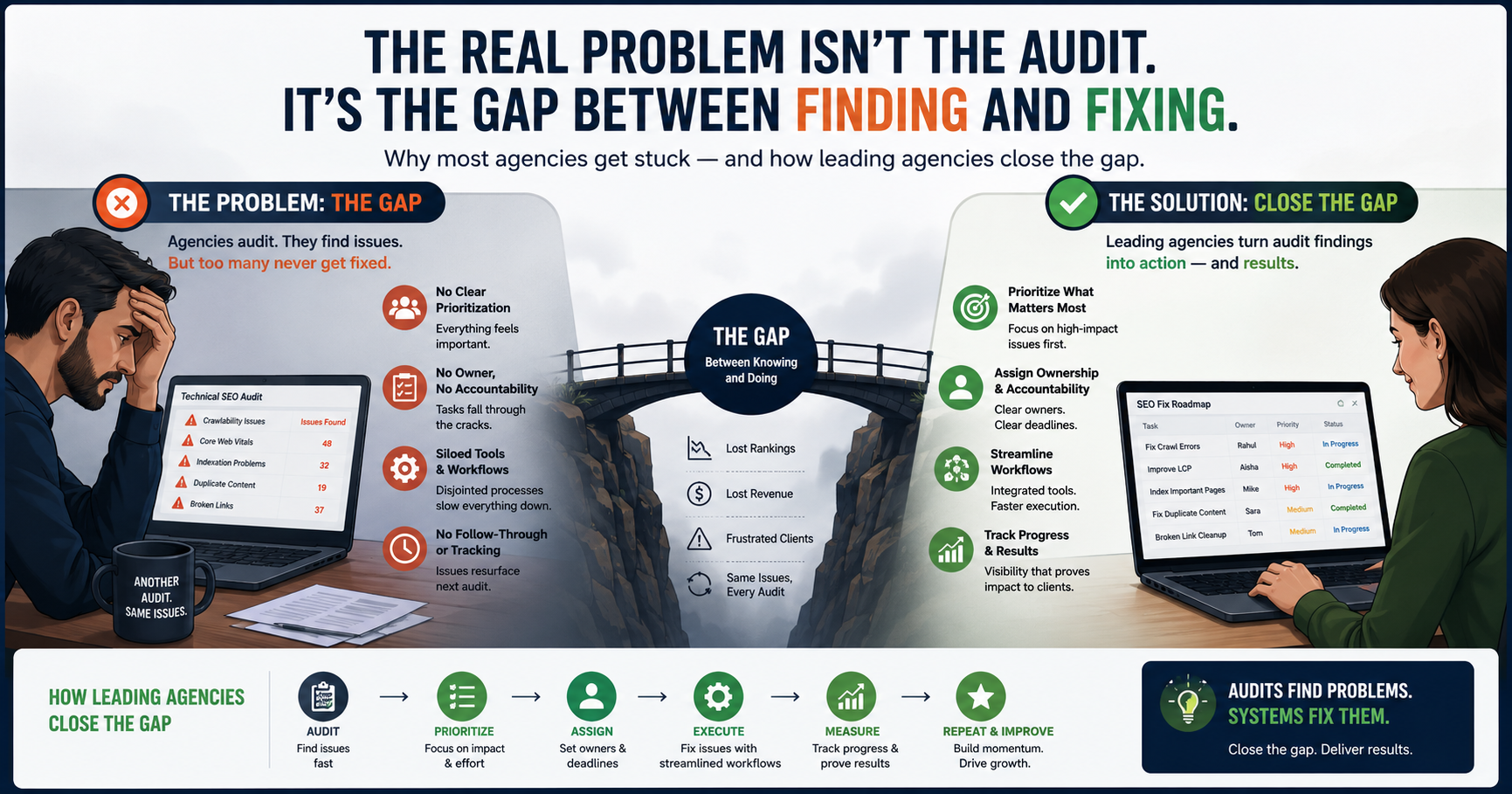
If you run SEO at an agency, you've lived this story: the audit is done, the findings are sharp, the prioritised fix list is sitting in a Google Doc — and three months later, not a single change has shipped to the client's site.
The client is wondering why rankings haven't moved. The account manager is fielding questions. The SEO lead is quietly frustrated. And the development team is buried under a backlog of product work.
This isn't a strategy problem. It's a delivery problem — and it's costing agencies client retention, reputation, and margin.
The five reasons SEO fixes stall in the handoff
1. The dev queue is not your queue
SEO fixes — even simple ones like updating a title tag or adding structured data — need to go through a developer. That developer is not on your team. They're on the client's product team, working from a product backlog ordered by product priorities, not SEO impact.
Your meta description change is competing with a feature sprint. It will lose. Every time.
2. Audit output doesn't map cleanly to implementation tasks
A well-written audit recommendation says: "Add LocalBusiness schema to the homepage." A developer needs to know: which schema fields to include, what values to use, where to inject the script tag, and how to validate it hasn't broken anything. That gap between recommendation and implementation task is filled by a senior SEO — manually, for every fix, for every client.
3. There's no validation step before go-live
Even when a fix does get implemented, there's no standard process for confirming it actually did what the audit recommended — and didn't break anything else. So either the fix ships without QA (risky) or someone does a manual crawl and spot-check (slow and inconsistent).
4. Priority conflicts kill momentum
Agencies work across multiple clients simultaneously. An SEO lead managing 8 accounts can't follow every fix through the dev handoff for all of them. Things slip. Fixes get re-discovered on the next audit. The cycle repeats.
5. Client approval gates add weeks
Before anything ships, the client often needs to approve it. That approval needs to come from someone technical enough to understand the change and authorised enough to greenlight it. Finding that person, scheduling the review, and waiting for sign-off can add 2–4 weeks to every single fix.
📌The average digital marketing agency takes 6–12 weeks to move from audit finding to deployed fix. For technical SEO changes, the gap is often longer. This isn't a capability problem — it's a process problem.
What high-velocity agencies do differently
The agencies that consistently close the gap between audit and implementation have a few things in common.
They convert findings to tasks automatically
Rather than handing a PDF to a developer, they output structured JSON from the audit — a machine-readable fix list that maps each finding to a specific code change. This removes the interpretation step entirely.
They own the implementation path
Leading agencies don't rely on client dev teams for technical SEO changes. They either have in-house developers or use tooling that generates the code change and opens a pull request directly — leaving client developers only to review and approve, not to build.
They validate before every merge
Automated validation runs before a fix ships — checking that the change is crawlable, the structured data passes Google's validator, Core Web Vitals haven't regressed, and nothing else has broken. This gives clients confidence and removes the manual QA step.
The 24-hour delivery model
The best-performing agencies are moving toward a model where audit findings can be deployed within 24 hours of identification — not 6 months. This requires three things:
- Structured audit output that maps directly to implementation tasks
- Automated code generation for technical SEO fixes
- Pre-ship validation with a human review gate before merge
This is exactly what we're building at Agentera — a three-agent system where the Strategist audits, the Developer implements, and the QA agent validates before anything ships.
What this means for your agency
If your team is consistently finding the right issues but struggling to close the loop on implementation, you're not alone. The handoff problem is structural — and it won't be solved by hiring more senior SEOs or sending better audit PDFs.
The agencies that win on client retention over the next 3 years will be the ones that can show measurable change, not just measurable findings. That requires owning the implementation path, not just the audit.
💡If you're ready to shorten the gap from audit to deployed fix, Agentera's Strategist agent is launching soon. Request early access to be part of the first group of agencies.