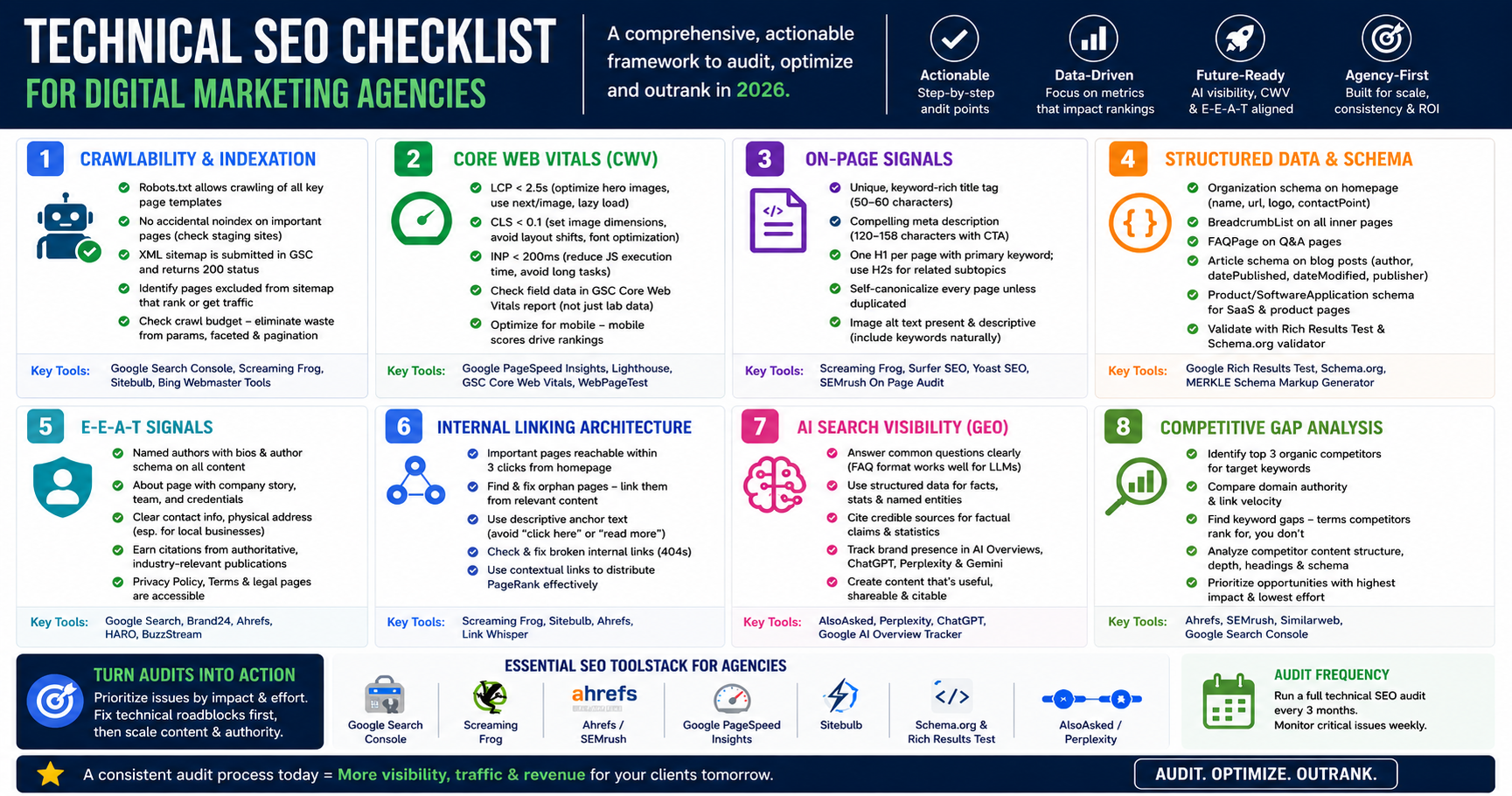
A technical SEO audit is only as good as the framework behind it. Without a systematic checklist, even experienced SEOs miss critical issues — especially across high-volume agency workflows where speed and consistency matter most.
This checklist covers eight audit layers used by leading agencies in 2026. It's designed to be run for every client engagement — whether you're doing a quick pre-sales competitive audit or a comprehensive in-depth review.
💡For agencies running 10+ audits per month, manual execution of this checklist is impractical. This is the audit framework the Agentera Strategist agent automates in under 5 minutes.
Layer 1: Crawlability & Indexation
Before anything else, confirm Google can actually reach and index the pages that matter. Crawlability issues silently suppress rankings — and they're often introduced accidentally by developers.
- Verify robots.txt allows crawling of all key page templates
- Check for noindex tags on pages that should be indexed (especially staging environments accidentally pushed to production)
- Confirm XML sitemap is submitted to Google Search Console and returns a 200 status
- Identify any pages excluded from the sitemap that rank or receive traffic
- Check crawl budget efficiency — paginated pages, faceted navigation, and parameter URLs being indexed unnecessarily
Layer 2: Core Web Vitals (CWV)
Google uses Core Web Vitals as a confirmed ranking signal. Poor CWV scores directly reduce your page's ability to rank competitively, particularly in close-match keyword scenarios.
- Largest Contentful Paint (LCP): Should be under 2.5 seconds. Check hero images — use next/image or lazy loading appropriately
- Cumulative Layout Shift (CLS): Should be under 0.1. Most common cause: images without explicit width/height, web font loading, and late-injected ads
- Interaction to Next Paint (INP): Replaced FID in 2024. Should be under 200ms. JavaScript-heavy pages are most at risk
- Check field data (real users) in GSC's Core Web Vitals report — lab data from PageSpeed alone is insufficient
Layer 3: On-Page Signals
On-page signals tell Google what each page is about. These are the highest-ROI fixes in most audits — cheap to implement, direct ranking impact.
- Title tags: One unique, keyword-rich title per page. 50–60 characters. Primary keyword near the front
- Meta descriptions: 120–158 characters. Include a CTA. Not a direct ranking signal but significantly affects CTR
- H1 hierarchy: One H1 per page containing the primary keyword. H2s should use secondary keywords
- Canonical tags: Every page should self-canonicalise unless content is duplicated elsewhere
- Image alt text: All images should have descriptive alt text including target keywords where natural
Layer 4: Structured Data & Schema
Structured data helps Google understand your content and enables rich results in SERPs. It's also increasingly important for AI visibility — LLMs use structured data to extract and cite information.
- Organization schema on the homepage with name, url, logo, and contactPoint
- BreadcrumbList on all inner pages — improves SERP display and signals site hierarchy
- FAQPage schema on any page with question-and-answer content — eligible for expanded SERP display
- Article schema on blog posts with author, datePublished, dateModified, and publisher
- SoftwareApplication or Product schema for SaaS pages — enables review stars and pricing in SERPs
- Validate all schema using Google's Rich Results Test and Schema.org validator
Layer 5: E-E-A-T Signals
Experience, Expertise, Authoritativeness, and Trustworthiness (E-E-A-T) isn't a direct ranking algorithm — it's a framework Google's quality raters use to evaluate pages. But it directly influences how Google weights your content.
- Named authors on all blog and editorial content with bio pages or author schema
- About page with company history, team, and founding story
- Clear contact information and physical address (especially for local businesses)
- Citations from recognised industry publications — backlinks from authoritative domains
- Privacy policy, terms, and legal pages — signals trustworthiness to both users and crawlers
Layer 6: Internal Linking Architecture
Internal links distribute PageRank across your site and signal to Google which pages are most important. Poor internal linking is one of the most commonly overlooked issues in technical audits.
- Every key page should be reachable within 3 clicks from the homepage
- Orphan pages (pages with no internal links pointing to them) should be identified and linked from relevant content
- Use descriptive anchor text — avoid generic 'click here' or 'read more' anchors
- Check for broken internal links (404s from within the site)
Layer 7: AI Search Visibility (GEO)
Generative Engine Optimisation (GEO) is emerging as a distinct discipline from traditional SEO. As AI-powered search (Google AI Overviews, Perplexity, ChatGPT search) becomes a primary discovery channel, your pages need to be structured for machine citation, not just keyword ranking.
- Structure content with clear, direct answers to common questions (FAQ format signals well to LLMs)
- Use structured data to make facts, statistics, and named entities machine-readable
- Ensure all factual claims have cited sources — LLMs favour citable content
- Check whether your brand appears in AI Overview responses for your primary keywords
Layer 8: Competitive Gap Analysis
No audit is complete without understanding where your client stands relative to the competitors who are ranking above them. Gap analysis turns abstract findings into prioritised opportunities.
- Identify the top 3 organic competitors for your client's primary keyword set
- Compare domain authority and link velocity — understand the ceiling before setting ranking targets
- Identify keyword gaps — terms competitors rank for that your client does not
- Analyse competitor content structure — topic depth, heading hierarchy, schema coverage
📌Running all eight layers manually takes 8–12 hours per domain. The Agentera Strategist agent runs all eight layers in parallel and delivers results in under 5 minutes — including a white-label PDF and prioritised fix list.
Technical SEO audits are only valuable if they lead to action. Use this checklist to ensure nothing critical is missed — and then make sure you have a clear path from finding to deployed fix before the audit lands with the client.